
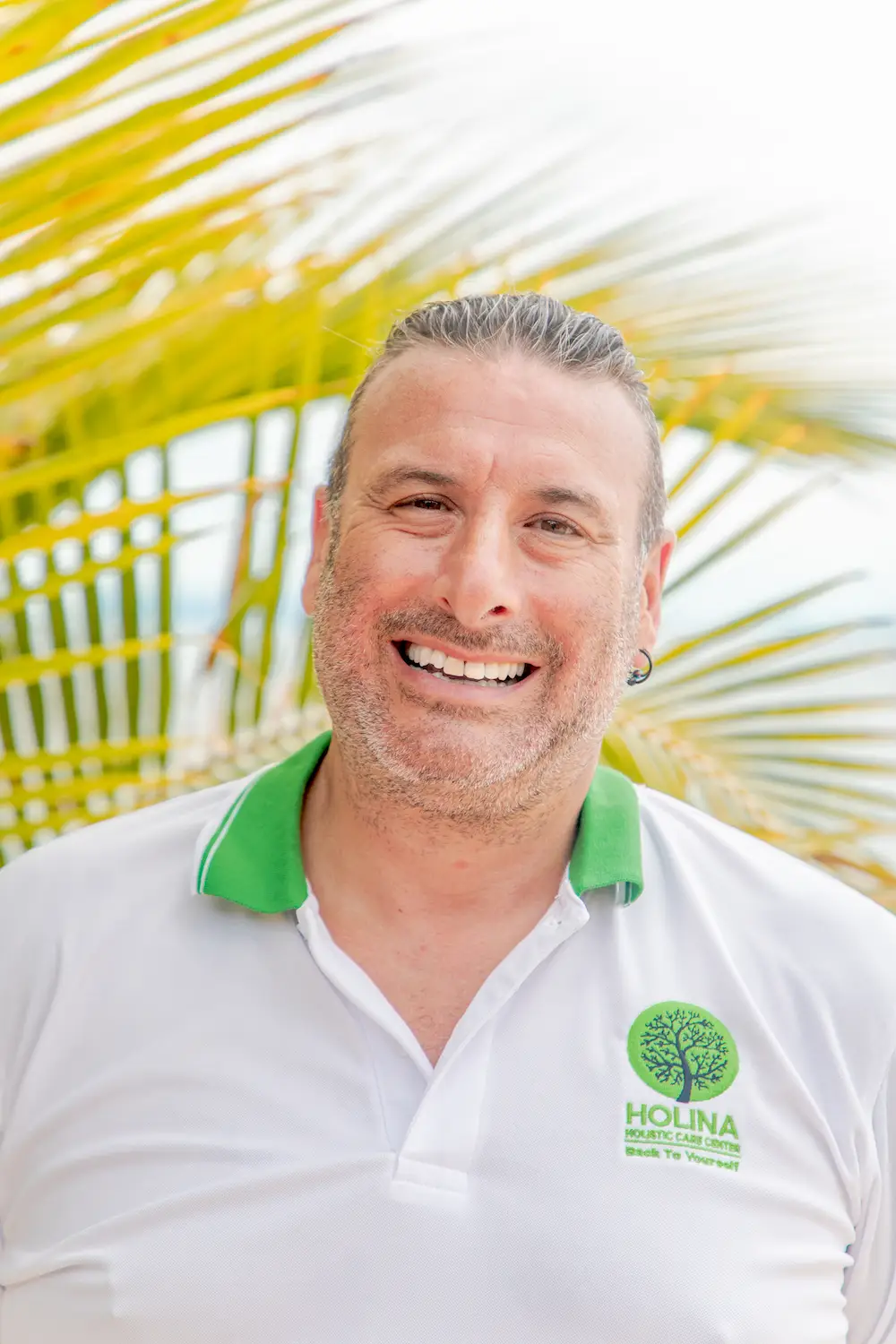

Clinically reviewed by William Morgan, Aqua Tuning Therapist, Holina Rehab. Review pending final sign-off.
For many people, addiction does not start with a substance. It starts with trauma. Post-traumatic stress disorder (PTSD) can leave the nervous system locked in a state of alarm, producing flashbacks, nightmares, anxiety, and constant hypervigilance, and alcohol or drugs can become a way to quiet that distress. Over time, what begins as relief hardens into dependence. This is why treating addiction without addressing the trauma underneath it so often fails to hold.
Trauma yoga, more accurately called trauma-sensitive yoga, is one of the body-based approaches that can support this work. It is not a cure and it is not a standalone retreat activity. At Holina Rehab in Koh Phangan, it is used as one adjunct modality within a structured, residential addiction-recovery programme, alongside clinical therapy and other trauma treatment. In this article we look at what trauma-sensitive yoga is, what the evidence does and does not show, and how it fits into trauma-informed addiction treatment. For more information, contact us on +66 82 113 0657 (international) or +66 61 936 8047 (Thai).
The Link Between Trauma and Addiction
Recovery starts with understanding why trauma and addiction so often travel together. Under the self-medication model, which has strong empirical support, people use substances to relieve distressing trauma-related symptoms; each use briefly dulls the distress, reinforcing the behaviour until it develops into a substance use disorder. The overlap is substantial: studies report that roughly 30 to 60 percent of people in addiction treatment also meet criteria for PTSD, and up to half of people with PTSD have a co-occurring alcohol or drug use disorder. This bidirectional relationship is a well-documented clinical challenge, not a marketing claim.
This is the clinical foundation of Holina’s Dual Treatment programme, which addresses addiction and its underlying psychological drivers, including trauma, at the same time rather than one after the other.
What Is Trauma-Sensitive Yoga?
Trauma-sensitive yoga is a form of yoga adapted for people who have experienced trauma. It differs from a typical yoga class in its intent: it is less about achieving a pose and more about helping you notice bodily sensations, move at your own pace, and rebuild a sense of choice and control that trauma often takes away. Instructors trained in the approach use invitational language rather than commands, offer modifications, and avoid pushing anyone past what feels safe.
The reasoning behind it is that trauma is not only a psychological memory but also a physiological state. When you experience a threat, the body enters a fight, flight, or freeze response. When that response does not fully resolve, the nervous system can remain stuck on high alert, showing up as muscle tension, chronic pain, fatigue, poor sleep, and a feeling of being disconnected from your own body. The claim that trauma is literally “stored” in the body is best understood as a working model of how the nervous system holds stress, rather than an established anatomical fact. What matters clinically is whether the practice helps, so it is worth being honest about the evidence.

What the Evidence Shows
The research base for trauma-sensitive yoga is promising but still modest. The most cited study is a 2014 randomised controlled trial by Bessel van der Kolk and colleagues, published in the Journal of Clinical Psychiatry. It followed 64 women with chronic, treatment-resistant PTSD from childhood trauma, comparing a ten-week trauma-sensitive yoga programme with a supportive women’s health education group. The yoga group showed a significantly greater reduction in PTSD symptoms, and some participants no longer met the diagnostic criteria for PTSD by the end.
That said, this remains one of only a small number of rigorous trials, and it studied a specific population as an add-on to other care, not as a replacement for it. Systematic reviews published since then describe the overall evidence for yoga in PTSD as moderate, with trauma-sensitive adaptations tending to show the best engagement and lowest drop-out rates. The honest summary is that trauma-sensitive yoga is a reasonable adjunct that can help some people manage symptoms, not a proven cure and not a substitute for clinical addiction and trauma treatment.
How Trauma-Sensitive Yoga Can Support Recovery
Within a treatment programme, the value of trauma-sensitive yoga is in what it can add to the rest of the clinical work. Benefits that clients commonly report include:
- Reconnecting with the body: gentle, self-directed movement can help rebuild a sense of safety in your own body after trauma has made it feel like an unsafe place.
- Nervous-system regulation: breathwork and grounding techniques can engage the parasympathetic nervous system, helping shift out of fight-or-flight and toward calm.
- Managing PTSD symptoms: some people find the combination of movement, breath, and mindfulness eases anxiety and intrusive thoughts and improves disrupted sleep.
- Emotional resilience: practising staying present with sensation, without becoming overwhelmed, can build tolerance for difficult feelings that might otherwise trigger substance use.
These are individual experiences rather than guaranteed outcomes, and they work best alongside the structured elements of drug addiction treatment and ongoing trauma treatment.

Safety Comes First
Trauma-sensitive yoga is not automatically gentle simply because it is called yoga. Certain postures, breathing patterns, or moments of stillness can bring up difficult sensations, and for someone in early recovery whose nervous system is already under strain, that can be destabilising. This is why it is delivered by trained facilitators within a clinical setting, where the emphasis is on working inside your “window of tolerance”, the range in which you can feel sensations without being overwhelmed, and where clinical support is on hand if something surfaces.
For people who want to go further into body-based trauma work, Holina also offers related approaches such as Somatic Experiencing, again as part of an individualised plan rather than as a standalone therapy.
Why Choose Holina Rehab
Holina Rehab in Koh Phangan provides trauma-informed addiction treatment delivered by an experienced clinical team. Trauma-sensitive yoga sits alongside talk therapy, group work, and other modalities within a holistic, individualised plan, so that the addiction and the trauma driving it are treated together rather than in isolation. The setting on Koh Phangan offers a calm environment for recovery, and every treatment plan is built around the person, not a fixed template.

“I have been to many rehabs! Since coming to Holina, I have been sober and, miraculously, my obsession with alcohol has been lifted. Holina’s holistic approach worked not only well for me, but for many of the friends I made when I first went there. I cannot sing its praises enough. All the staff, from the director and head therapist/counsellor down to the cleaners and maintenance staff were kind and compassionate and made me feel safe and cared for.”
— Rodney B, 25 Mar 2025
If you or someone you love is struggling with addiction and unresolved trauma, Holina’s team can talk you through the options. Contact us on +66 82 113 0657 (international) or +66 61 936 8047 (Thai) to learn more about our Dual Treatment programme.
Ready to Start Your Recovery Journey?
Our clinical team is available to answer your questions and help you find the right programme for your needs.
Speak with Our Team →