
Clinically reviewed by Dr. Aviva Wolf — Consultant Psychiatrist · Last reviewed 7 July 2026
The landscape of addiction medicine has changed profoundly over the past decade. Where residential treatment once relied almost exclusively on talk therapy and 12-step frameworks, many contemporary rehabilitation centres are now integrating sophisticated neuroscientific technologies that work directly with the brain’s own chemistry, circuitry, and capacity for healing. For people seeking rigorous, evidence-informed care — and for families trying to navigate an overwhelming number of options — understanding what these technologies actually do, and how they differ, has never been more important.
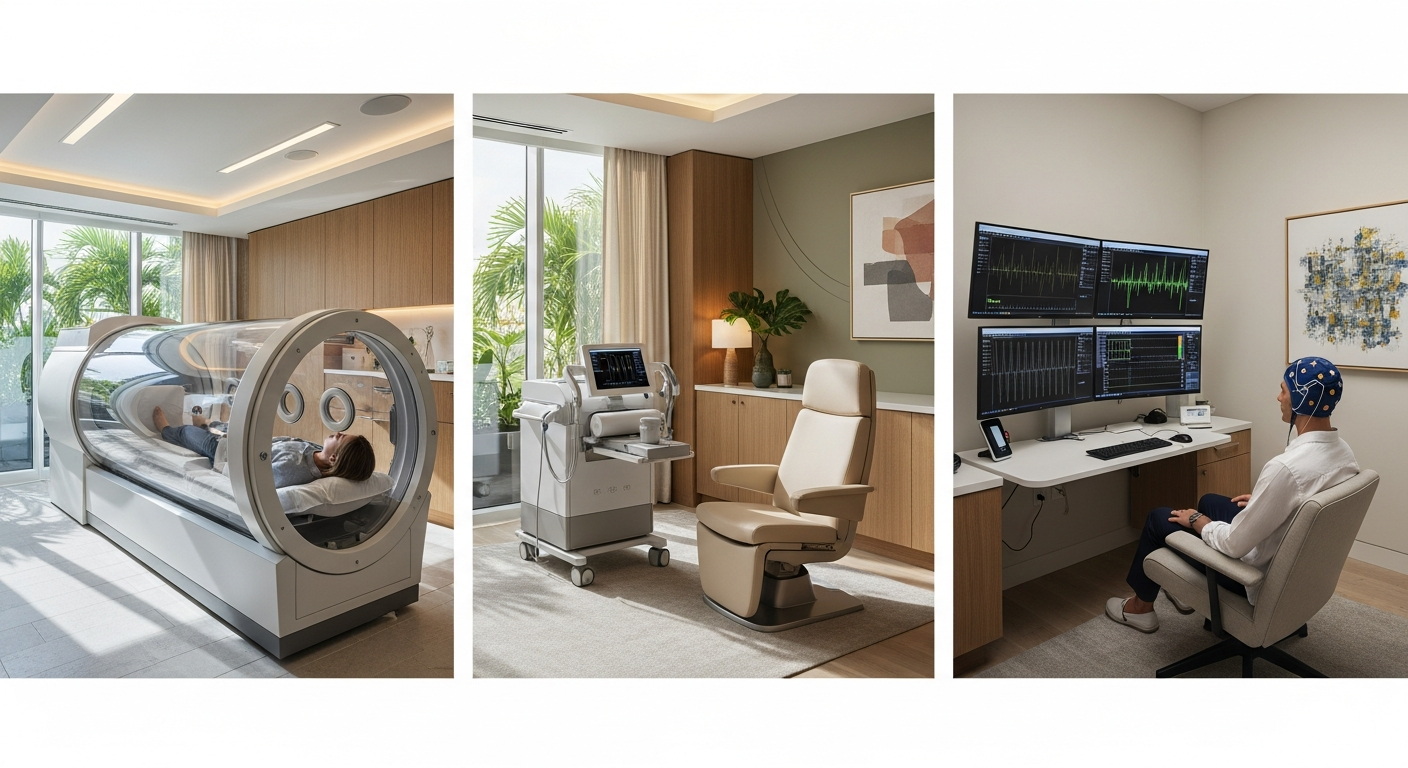
Three approaches in particular have generated significant clinical interest and are increasingly available at residential programmes worldwide: Hyperbaric Oxygen Therapy (HBOT), Transcranial Magnetic Stimulation (TMS), and Neurofeedback. Each targets the neurological consequences of addiction through a distinctly different mechanism. Each carries its own body of evidence, its own ideal candidate profile, and its own role within a broader, personalised treatment plan. Comparing HBOT vs TMS for addiction, or weighing neurofeedback vs HBOT, is not a matter of ranking one technology above another — it is a matter of identifying which combination is best suited to a specific individual at a specific stage of their recovery.
At Holina Rehab on Koh Phangan, Thailand, physician-supervised brain stimulation and addiction therapy protocols are woven into a holistic residential programme designed around each guest’s unique neurological profile, trauma history, and recovery goals. In the sections that follow, we break down exactly how HBOT, TMS, and Neurofeedback work, what the research says, and how our clinical team — including Consultant Psychiatrist Dr. Aviva Wolf — uses these technologies to support lasting, meaningful change.
Understanding the Science Behind Modern Addiction Treatment Technologies
Addiction is not simply a matter of willpower or poor decision-making. Decades of neuroscience research have confirmed what clinicians have long suspected: substance use disorders and co-occurring trauma fundamentally alter the structure and function of the brain. The prefrontal cortex — responsible for impulse control, decision-making, and emotional regulation — becomes dysregulated. Dopamine pathways are remodelled. The stress-response system is chronically activated. Recovery, then, is not just about stopping substance use; it is about restoring the brain’s capacity to function, feel, and heal.
This understanding has given rise to a new generation of evidence-informed treatment technologies designed to work alongside personalised therapy, physician-supervised medical care, and holistic residential programming. Three of the most widely discussed and clinically studied among these are Hyperbaric Oxygen Therapy (HBOT), Transcranial Magnetic Stimulation (TMS), and Neurofeedback. Each targets different aspects of neurological and physiological dysfunction caused by prolonged substance use, and each has a body of clinical research exploring its role in comprehensive addiction recovery — though, as outlined below, that evidence base is considerably more mature for some applications than others.
Before comparing these approaches, it is worth understanding why adjunctive brain-based therapies matter in the first place. Standard addiction treatment — however well delivered — addresses behaviour, psychology, and relationship patterns. What it cannot always reach directly is the underlying neurobiological damage that makes cravings so powerful, emotional dysregulation so persistent, and relapse so common in early recovery. This is precisely the gap that emerging technologies aim to fill.
When integrated thoughtfully into a residential treatment programme, these modalities can support clients in several clinically significant ways:
- Reducing neuroinflammation caused by chronic alcohol, opioid, or stimulant use, which contributes to cognitive fog, low mood, and physical fatigue in early recovery
- Restoring disrupted neural circuits associated with reward, motivation, and executive function that substance use has progressively impaired
- Improving emotional regulation by supporting the brain’s ability to self-correct, reducing anxiety, reactivity, and the intensity of cravings
- Accelerating cognitive recovery, helping clients engage more fully and productively with psychotherapy, trauma processing, and relapse prevention work
- Supporting sleep architecture, which is profoundly disturbed in most people entering residential treatment and is critical to sustained recovery outcomes
It is important to note that none of these technologies function as standalone solutions. Their value lies in precise, personalised integration within a broader physician-supervised treatment plan — one that accounts for each client’s unique history, substance use profile, co-occurring behavioural health conditions, and recovery goals. In the sections that follow, we examine what HBOT, TMS, and Neurofeedback each offer, how they differ, and how a licensed residential rehab environment brings them together with purpose and clinical rigour — Holina Rehab operates under Thai Ministry of Public Health licence #84-03-00294.
TMS Therapy: Rewiring the Brain’s Reward and Mood Circuits
Transcranial Magnetic Stimulation — commonly known as TMS — uses precisely targeted, rapidly alternating magnetic fields to stimulate or inhibit specific regions of the brain. In addiction and co-occurring mood disorder treatment, the prefrontal cortex is the primary area of focus. This region governs impulse control, decision-making, and emotional regulation — all functions that are significantly disrupted by prolonged substance use. By delivering focused magnetic pulses to this area, TMS works to encourage more balanced neural activity in circuits that addiction has thrown into disarray.
The science behind TMS for depression is well established: the technology has held FDA clearance for treatment-resistant depression since 2008. Its use in addiction medicine is newer, and the evidence, while genuinely promising, is still preliminary and mixed. A 2022 meta-analysis pooling 34 controlled studies found that repetitive TMS produced a small but statistically significant reduction in cravings for stimulant drugs (nicotine, cocaine, methamphetamine) and behavioural addictions — but did not find a significant benefit for alcohol use disorder, cannabis, or opioid use specifically. The researchers behind that analysis describe their findings as promising rather than conclusive, noting high variability between studies and calling for larger, more standardised trials before firm treatment recommendations can be made. We think it is more honest to name that distinction clearly than to imply TMS works equally well across every substance.
In a residential treatment setting, TMS is delivered in sessions typically lasting 20 to 40 minutes, conducted over several weeks as part of a broader, physician-supervised programme. There is no sedation required. Clients remain fully conscious and can return to therapy sessions, group work, or leisure activities immediately afterward. This makes it compatible with the intensive therapeutic schedule of a residential programme, where every element of the day is designed to support healing.
TMS is particularly of interest for clients presenting with dual diagnoses — addiction alongside depression, PTSD, or anxiety — which describes a significant proportion of those seeking residential treatment. Standard pharmacological approaches often fall short for this population, either because medication produces unwanted side effects, fails to reach therapeutic levels, or cannot address the neurological dimension of addiction directly. For the depression component specifically, TMS has the strongest and longest-standing evidence base of the three technologies discussed here.
Potential clinical applications of TMS within an addiction treatment programme include:
- Potentially reducing the intensity and frequency of substance cravings, with the clearest evidence for stimulant and behavioural addictions, during early and mid-recovery
- Supporting improved prefrontal cortex function associated with impulse control and emotional regulation
- Alleviating treatment-resistant depression that frequently underlies addictive behaviour — its most well-established, FDA-cleared application
- Helping reduce hyperarousal and intrusive symptoms associated with trauma and PTSD
- Supporting motivation and engagement in psychotherapy and group therapeutic work
It is worth noting that TMS is not a standalone intervention. Its clinical value is realised most fully when it is integrated within a comprehensive, personalised treatment plan that includes evidence-based psychotherapy, nutritional support, and structured aftercare. When layered thoughtfully alongside other modalities, TMS offers a genuine, evidence-supported contribution to the neurological restoration that sustained recovery depends upon.
Which Technology Is Right for You? How Holina Integrates All Three
Choosing between HBOT, TMS, and neurofeedback is rarely a straightforward decision, and it should never be made in isolation. Each technology addresses a different dimension of addiction and its neurological impact — and for many clients, the most meaningful progress comes not from selecting one modality, but from understanding how all three can work together within a carefully structured, physician-supervised treatment plan.
At Holina Rehab, every client begins with a thorough clinical assessment that evaluates physical health, substance history, co-occurring behavioural health conditions, sleep quality, cognitive function, and trauma background. This intake process is what allows the treatment team to make genuinely informed recommendations rather than applying a one-size-fits-all protocol.
As a general clinical framework, the following patterns tend to guide technology selection:
- HBOT is often prioritised for clients presenting with significant physical depletion, a history of heavy or prolonged substance use, post-acute withdrawal symptoms, or neurological concerns related to long-term alcohol or stimulant use. It is particularly relevant in the early-to-mid phase of residential treatment, when the brain and body are still in active recovery. HBOT’s proposed mechanisms — including reduced neuroinflammation, improved cerebral blood flow, and support for neuroplasticity — are outlined in a 2024 review of hyperbaric oxygen as a neuromodulatory therapy.
- TMS is typically considered when persistent depression, anxiety, or intense cravings remain present after stabilisation, and when a client has not responded adequately to medication alone. Its ability to directly modulate prefrontal cortical activity makes it especially relevant for those whose addiction has been accompanied by mood dysregulation or impulsive decision-making patterns.
- Neurofeedback is incorporated throughout the treatment journey, and is particularly well-suited to clients dealing with trauma, chronic stress, sleep disruption, or attentional difficulties. Because it builds self-regulation skills that clients carry with them beyond discharge, it holds real promise as a bridge between residential treatment and long-term recovery — though a 2025 review of the neurofeedback evidence base for addiction describes results as encouraging but still preliminary, and calls for larger, more rigorously controlled trials before its role can be considered established.
“In more than twenty-five years treating addiction, I have never found one technology that works for every patient. HBOT, TMS, and neurofeedback each address a different piece of the recovery picture — the question I ask is never which one is ‘best’, but which combination, and in what order, will actually serve this person’s brain and history.”
— Dr. Aviva Wolf, Consultant Psychiatrist, Holina Rehab (draft quote, pending Dr. Wolf’s personal review and sign-off)
What distinguishes a truly integrated approach is sequencing. Administering these modalities thoughtfully — rather than simultaneously or randomly — allows each one to build on the progress of the last. A client who has completed a course of HBOT sessions may find their brain more receptive to neurofeedback training. A client who has achieved greater emotional stability through TMS may engage more meaningfully in psychotherapy and group work.
At Holina, these technologies are never offered as standalone solutions. They sit within a broader programme — reflected in our published programme pricing rather than billed as surprise add-ons — that includes individual psychotherapy, trauma-informed care, mindfulness practices, nutritional medicine, and structured aftercare planning. The goal is not simply symptom reduction — it is helping each client rebuild a neurological and psychological foundation strong enough to sustain a genuinely different life.
If you are exploring treatment options for yourself or someone you love, we encourage you to reach out to our admissions team for a confidential conversation. Understanding which combination of approaches fits your unique situation is the first and most important step.
“the facilities are amazing… the love care and patience from everyone there as well as the knowledge massively helped me.”
— Matthew Hill, Google, 1 Apr 2026 · ★★★★★
Choosing the right combination of therapeutic technologies is one of the most consequential decisions in addiction recovery. Hyperbaric Oxygen Therapy, Transcranial Magnetic Stimulation, and Neurofeedback each address distinct dimensions of neurological and physiological damage caused by prolonged substance use. HBOT works at the cellular level, aiming to restore oxygen supply to brain tissue compromised by years of toxic exposure. TMS targets the prefrontal cortex directly, with the clearest evidence in stimulant and behavioural addiction, mood, and depression. Neurofeedback, meanwhile, trains the brain’s own electrical rhythms, with early research suggesting it may build resilience against stress responses that so frequently trigger relapse long after physical withdrawal has resolved.
What sets genuinely comprehensive residential treatment apart is not the availability of any single technology, but the clinical wisdom to know when, how, and for whom each modality is most appropriately deployed — and the honesty to be clear about where the evidence is strong and where it is still developing. A physician-supervised, personalised programme integrates these tools within a broader framework of trauma-informed psychotherapy, nutritional medicine, and compassionate human connection — because neuroscience alone cannot heal a whole person.
At Holina Rehab on the serene island of Koh Phangan, Thailand, these evidence-informed technologies are woven into a bespoke residential programme designed around each individual’s unique neurobiology and life history. If you or someone you love is ready to explore what genuinely comprehensive, medically grounded recovery looks like, we warmly invite you to reach out to our admissions team today.
Ready to Start Your Recovery Journey?
Our clinical team is available to answer your questions and help you find the right programme for your needs.
Speak with Our Team →