
There is something that happens to people when they arrive on Koh Phangan. The salt air, the temple bells carried on the evening breeze, the unhurried rhythm of an island that has held Buddhist traditions for centuries — something in the nervous system begins, almost involuntarily, to soften. For those arriving at Holina carrying the weight of trauma, addiction, or both, that softening is not incidental. It is the beginning of something clinically meaningful.
Reviewed by Adrian Solomon — Counselling Psychologist, Holina Rehab. Last reviewed: 7 July 2026.
Thai Buddhist healing and trauma recovery share a profound and rarely discussed common ground. Both are fundamentally concerned with the same human challenge: learning to relate to pain differently. Buddhist philosophy — woven into the landscape, the culture, and the daily rituals of life in Thailand — offers a framework for suffering that does not pathologise it, but contextualises it. This is not a passive or mystical idea. When integrated thoughtfully alongside evidence-based clinical treatment, the Buddhist cultural setting of Koh Phangan becomes a genuine therapeutic accelerant.
At Holina Rehab, we recognised early that the environment in which healing happens is not separate from the healing itself. Our physician-supervised, personalised programmes are designed to work in conscious harmony with the island’s spiritual character — drawing on Buddhist philosophy not as decoration, but as a living framework that supports the psychological and emotional work our residents are doing every single day. The result is a Thailand rehab Buddhist setting unlike anything available in conventional Western treatment centres, one where the ancient and the clinical are not in tension, but in conversation.
The Ancient Roots of Mindfulness: What Buddhist Philosophy Actually Offers Trauma Recovery
Long before the clinical world had a name for post-traumatic stress, Buddhist philosophy was grappling with the same fundamental question: why does suffering persist, and what does the mind need in order to release it? The answer that emerged over 2,500 years of practice in Southeast Asia is remarkably aligned with what modern neuroscience now confirms about trauma, the nervous system, and lasting psychological change.
At the heart of Thai Buddhist philosophy are three interlocking concepts that carry direct, practical relevance for anyone recovering from trauma, addiction, or both. Understanding these principles — not as religious doctrine, but as clinical tools — helps explain why Holina’s location on Koh Phangan is far more than an aesthetic choice.
The first is anicca, or impermanence. Trauma memory has a particular cruelty: it presents the past as permanent, as present, as inevitable. The nervous system locked in a trauma response genuinely cannot distinguish between memory and reality. Buddhist practice — specifically mindfulness meditation rooted in the Thai Theravāda tradition — trains the mind to observe thoughts, feelings, and sensations as passing events rather than fixed truths. This directly parallels what our trauma-informed therapists do in evidence-based modalities such as EMDR and Somatic Experiencing: building the capacity to witness internal experience without being consumed by it.
The second concept is dukkha, often translated as suffering, but more precisely understood as the discomfort that arises when we resist what is. Addiction, at its neurological core, is often a learned strategy for managing unbearable internal states — pain, shame, hyperarousal, numbness. Buddhist philosophy does not ask a person to suppress or eliminate these states. It teaches a different relationship with them, one of acknowledgement without attachment. This is not passive resignation. It is an active, practised skill that supports the emotional regulation work central to our trauma treatment programme.
The third is sangha — the healing power of community and shared intention. Recovery from trauma and addiction is rarely a solitary journey. The Thai cultural emphasis on collective wellbeing, compassion, and non-judgement creates a social environment that is genuinely therapeutic in its own right.
- Mindfulness practices rooted in Theravāda Buddhism are now validated by decades of peer-reviewed research in anxiety, PTSD, and substance use disorder, including foundational work by addiction researcher Dr. Judson Brewer on mindfulness training and craving
- The concept of impermanence directly supports neuroplasticity-based treatment by reinforcing that the brain’s trauma patterns are changeable, not permanent
- Community and compassionate presence — central to Thai Buddhist culture — reduce the shame and isolation that sustain both trauma and addictive cycles
- Non-reactive awareness, cultivated through daily meditation practice, builds the same distress tolerance skills targeted in Dialectical Behaviour Therapy (DBT)
What makes this relevant to a modern residential treatment setting is that these are not abstract ideas. They are practised — in temples, in daily life, in the rhythms of a culture that has woven contemplation into its social fabric for centuries. When a person arrives at Holina carrying the weight of complex trauma or long-term substance dependence, they step into an environment where these principles are not imported or simulated. They are simply present, woven into the air, the pace, and the landscape of Koh Phangan itself.
How Buddhist Principles Map Onto Evidence-Based Trauma Therapy
What makes Holina’s setting genuinely therapeutic — rather than simply beautiful — is the degree to which Thai Buddhist philosophy aligns with the neurological and psychological mechanisms that modern trauma science has identified as essential to recovery. This is not a superficial overlap. The convergence runs deep, and our clinical team deliberately draws on it when designing each resident’s personalised treatment plan.
Consider the Buddhist concept of anicca, or impermanence. At its core, this teaching holds that no mental state, sensation, or circumstance is fixed or permanent. For someone living with trauma, this principle carries profound clinical weight. Trauma, by its neurological nature, creates the illusion of permanence — the amygdala encodes threatening experiences in a way that makes the past feel relentlessly present. Cognitive processing therapies and EMDR work, in part, by helping the brain update those fixed threat signals. Anicca offers the same invitation from a contemplative direction: the suffering you are experiencing right now is not the final word on who you are.
Buddhist mindfulness practice — sati — is equally significant. The secular adaptation of mindfulness that underpins Mindfulness-Based Stress Reduction (MBSR) and Mindfulness-Based Cognitive Therapy (MBCT) draws directly from this tradition. Neuroimaging research from Harvard Medical School’s Dr. Sara Lazar found that eight weeks of sustained mindfulness practice produces measurable structural changes in brain regions associated with stress regulation, attention, and emotional integration (Harvard Gazette, 2011) — precisely the neurological repair that trauma recovery requires. At Holina, residents engage with mindfulness not as a wellness add-on but as a clinically purposeful daily practice, supported by physician supervision and integrated with individual therapy sessions.
The Buddhist framework of dukkha — often translated as suffering, but more precisely meaning the unsatisfactoriness that arises from clinging — also resonates with how addiction and trauma intersect. Many residents arrive having used substances or compulsive behaviours as a way of holding on: to numbness, to control, to a version of themselves that felt safer before the wound. Understanding that the clinging itself perpetuates suffering can be transformative, and our therapists use this lens alongside Acceptance and Commitment Therapy (ACT) to help residents develop psychological flexibility.
- Impermanence (anicca) — reinforces neurological truth that traumatic states can and do shift with the right therapeutic conditions
- Mindful awareness (sati) — directly supports the evidence base for MBSR, MBCT, and somatic trauma therapies
- Non-clinging (upadana) — aligns with ACT principles around psychological flexibility and releasing avoidance behaviours
- Compassion (karuna) — mirrors the self-compassion protocols embedded in trauma-focused CBT, reducing shame as a barrier to engagement
- Community (sangha) — reflects the clinical evidence that therapeutic alliance and peer connection are among the strongest predictors of sustained recovery
Living on Koh Phangan, surrounded by a culture in which these principles are not abstract philosophy but lived daily reality — in temple bells at dawn, in the gentle formality of Thai social interaction, in the presence of monks walking the roads at first light — means residents absorb this framework not only in the therapy room but in every sensory layer of the day. That ambient reinforcement is something no urban clinic can replicate, and it is one of the reasons our holistic, residential model is designed to support outcomes that many residents describe as more meaningful than what they experienced in previous treatment settings.
How Holina Weaves Buddhist Philosophy Into Evidence-Based Trauma Treatment
The integration of Thai Buddhist philosophy at Holina is not decorative — it is deliberate, clinically informed, and woven into every layer of the therapeutic programme. Situated within the natural sanctuary of Koh Phangan, Holina’s physician-supervised clinical team draws on both contemporary trauma science and centuries of contemplative wisdom to create a residential experience that addresses not just symptoms, but the deeper roots of suffering.
At the neurological level, trauma keeps the nervous system locked in hypervigilance — a state of chronic threat response that makes genuine healing almost impossible. Buddhist-derived mindfulness practices, particularly those rooted in sati (present-moment awareness), have been shown in peer-reviewed research — summarised by the National Center for Complementary and Integrative Health — to support emotional regulation and stress reactivity, mechanisms consistent with the prefrontal cortex changes documented by Dr. Sara Lazar’s research team. At Holina, these practices are not offered as optional wellness add-ons. They are integrated into a personalised treatment plan alongside EMDR, trauma-focused cognitive behavioural therapy, and somatic approaches — creating a genuinely comprehensive pathway through complex trauma and co-occurring addiction.
Practically, this integration looks like the following:
- Structured mindfulness sessions guided by practitioners familiar with both the Theravāda tradition and modern trauma-sensitive facilitation — ensuring that awareness practices are introduced safely, at a pace appropriate to each resident’s window of tolerance
- Impermanence work embedded within individual therapy, helping residents cognitively and somatically process the Buddhist concept of anicca — that pain, like all phenomena, does not last — reducing catastrophic thinking patterns common in trauma and early recovery
- Loving-kindness (mettā) practices used therapeutically to rebuild self-compassion in residents whose trauma history has produced profound shame, self-blame, or difficulty tolerating positive emotional states
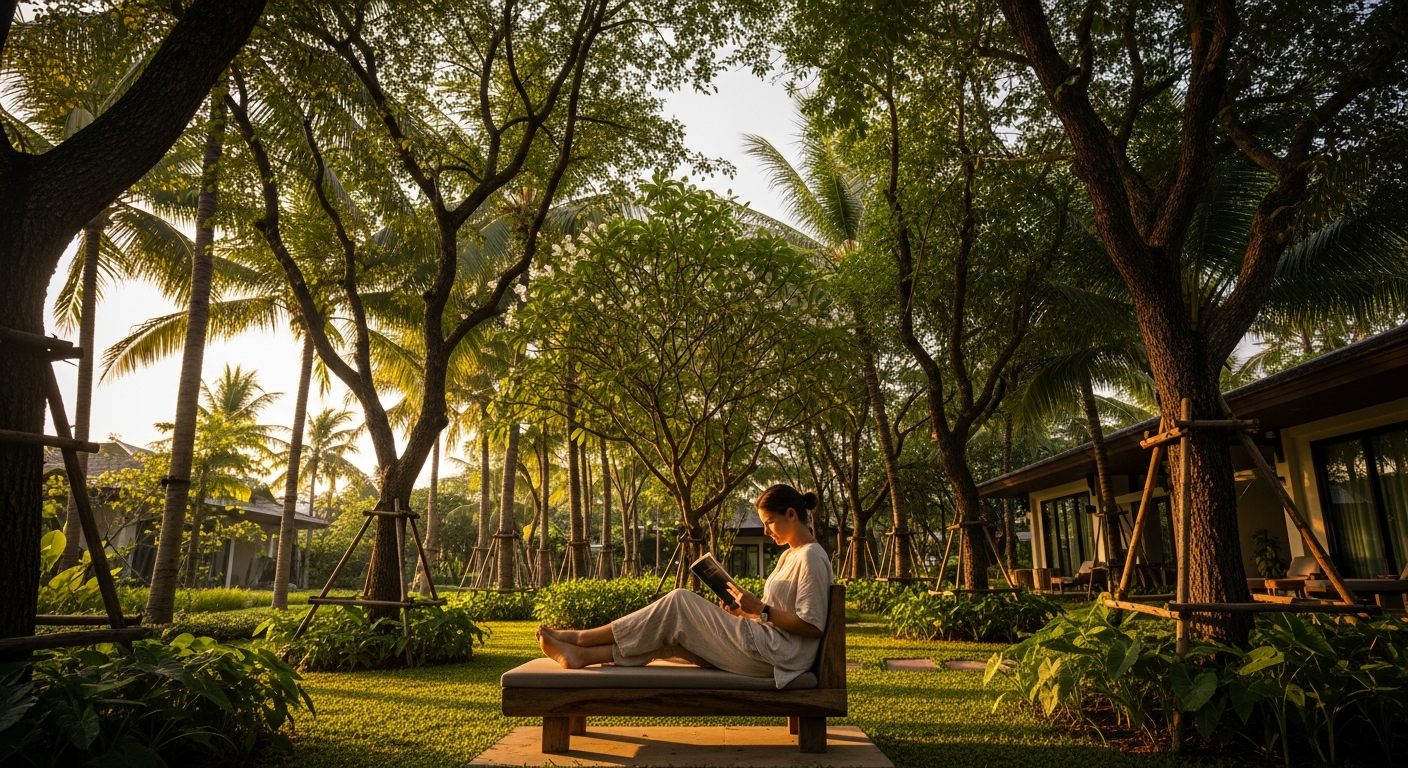
- The physical environment itself as a therapeutic tool — morning movement on open-air terraces, temple visits, and quiet time within tropical gardens are all structured to support parasympathetic nervous system restoration
Every element is personalised. Holina’s small, intimate residential model means that no two treatment journeys are identical. A senior physician oversees each resident’s programme, adjusting the balance of clinical therapy and contemplative practice as recovery progresses.
For adults who have carried trauma across years or decades, this setting — culturally rich, clinically rigorous, and genuinely beautiful — offers something that a conventional clinical environment rarely can: the felt sense that healing is not only possible, but already, quietly, beginning.
Healing from trauma is rarely a linear journey, and it is almost never a solitary one. At Holina Rehab, the ancient wisdom embedded in Thai Buddhist philosophy — the practice of mindful awareness, the cultivation of self-compassion, the understanding of impermanence — is not simply offered as a cultural backdrop. It is woven deliberately and precisely into every layer of a clinically rigorous, physician-supervised treatment programme designed to address the neurobiological, psychological, and relational wounds that trauma leaves behind.
The island setting of Koh Phangan is not incidental. Research summarised by the National Center for Complementary and Integrative Health indicates that mindfulness practice, supported by a calm natural setting, can help regulate stress reactivity and support the physiological conditions of safety that trauma recovery genuinely requires. When the nervous system is no longer in a chronic state of hypervigilance, the evidence-based therapeutic work — including trauma-focused cognitive behavioural therapy, EMDR, somatic processing, and personalised psychiatric care — can reach the deeper layers of the self that conventional clinical environments so often struggle to access.
This integration of place, philosophy, and clinical precision is what makes Holina’s approach genuinely distinctive rather than simply aesthetically appealing.
“We met with a monk every week and spent Saturday nights immersed in a sound bowl healing session.”
“Residents often tell us the temple bells at dawn do something a therapy room alone cannot. Our job is to make sure that calm is matched by clinically rigorous work in the room, not left to the setting on its own.”
— Adrian Solomon, Counselling Psychologist, Holina Rehab (quote drafted for this article, pending specialist approval)
If you or someone you love is ready to begin a personalised, holistic healing journey in a truly restorative environment, we warmly invite you to reach out to the admissions team at Holina Rehab today. A meaningful, lasting recovery is possible — and it can begin here.
Ready to Start Your Recovery Journey?
Our clinical team is available to answer your questions and help you find the right programme for your needs.
Speak with Our Team →