For many people carrying stress, burnout, or trauma, talk therapy eventually reaches a point where understanding a problem intellectually is no longer enough to shift it. That is part of why creative and “bottom-up” therapies have grown in popularity, and why so many people now ask a simple question: what is art therapy, and does it actually help mental health?
This guide answers that honestly. Art therapy is a recognised mental health practice with a real, if still growing, evidence base — and at Holina Rehab Koh Phangan, a licensed residential rehab and detox clinic (#84-03-00294), it is one part of a broader clinical programme rather than a treatment on its own. Below we look at what art therapy is, what the research supports, and how the setting can help the work take root.
What Is Art Therapy?
The American Art Therapy Association defines art therapy as a mental health profession in which trained, master’s-level clinicians use active art-making, the creative process, and applied psychological theory within a therapeutic relationship to support wellbeing.1 A central point is that you do not need to be “good at art” to benefit — often the most useful moments come when someone lets go of the idea of performing and simply lets the materials lead.
The Neurobiology of Creating
Making art engages several parts of the brain at once. The tactile experience of a medium — clay, paint, charcoal — grounds attention in the present, while the visual, non-verbal nature of the work draws on processes involved in intuition and emotional expression. For someone whose feelings are too large or too raw for words, art can act as a container: by putting pain onto a canvas or into a form, a person can begin to view it from a small distance. That shift, from “I am my pain” to “this is something I made that represents my pain,” is often a meaningful first step toward reclaiming a sense of agency.
What the Research Supports
One of the clearest findings comes from a 2016 study published in the journal Art Therapy. Researchers measured the stress hormone cortisol in 39 adults before and after 45 minutes of art-making. Cortisol fell in about 75% of participants, and — importantly — the effect was not related to prior art experience or skill.2 That supports what art therapists observe in practice: the act of creating, for most people, is calming regardless of the result.
It is worth being measured here. Art therapy is a supportive, evidence-informed practice; it is not a substitute for medical care or trauma-focused psychotherapy. The most reliable claim the research supports is that engaged creative activity tends to reduce acute stress and offers a non-verbal route to emotional expression — which is exactly why it works well alongside clinical treatment rather than instead of it.
Stress, Burnout, and Emotional Expression
In practice, residents use art therapy in a few overlapping ways. It can lower acute stress, as the cortisol research suggests. It offers a way to externalise and process difficult material that has been hard to speak about. And the absorbed, focused quality of creative work — sometimes described as a “flow” state — can be a healthy, self-directed source of enjoyment and mastery for people rebuilding a life without a substance. We present these as genuine benefits without overstating the mechanisms behind them.
The Limits of Outpatient and Digital Options
Many people first meet creative therapies through an outpatient studio or an app. These have real value, especially for maintenance and self-care. But outpatient work has a well-known limitation: an hour of vulnerable, valuable work is often followed immediately by a return to the same noise, commute, and triggers that contributed to the difficulty in the first place. Private one-to-one sessions can also be costly, and waiting lists for specialist creative therapy can be long. Digital tools, similarly, cannot provide the sustained, contained environment that deeper work sometimes needs.
Why the Environment Matters
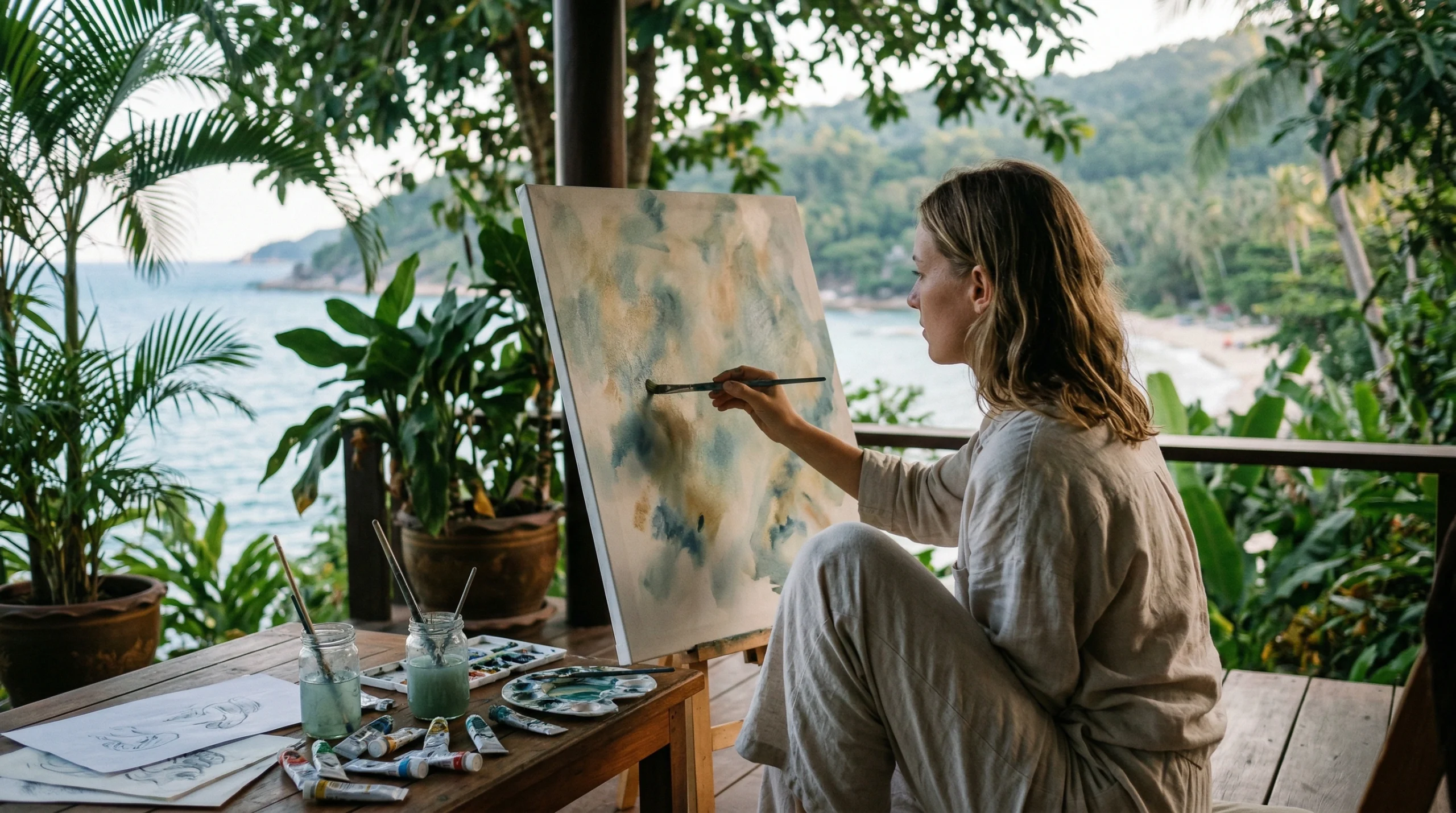
There is reasonable evidence that natural settings, and proximity to water in particular, are associated with lower stress and better wellbeing. A systematic review of the health effects of “blue spaces” found consistent associations between contact with water environments and improved mental wellbeing and reduced distress, while noting that the mechanisms are still being studied.3 Holina sits on the quiet side of Koh Phangan; residents often work in open, sea-facing studio space. We treat that natural setting as a supportive backdrop for therapeutic work, not as a clinical intervention on its own.
How Art Therapy Fits Into Treatment at Holina
Art therapy at Holina is delivered by a qualified art therapist and integrated with the wider clinical programme rather than offered in isolation. A resident’s week may include one-to-one and group creative sessions alongside somatic therapies, trauma-focused work through our trauma treatment programme, and 24/7 medical support. Where residents also access adjunctive supports such as hyperbaric oxygen therapy, these are offered as complements to, never replacements for, the core clinical and psychotherapeutic work. You can read more about our facilities and setting on the rehab facilities page and meet the practitioners on our rehab team page.
Programmes and Pricing
Holina’s residential programmes are all-inclusive, covering accommodation, 24/7 clinical care, chef-prepared meals, all therapy sessions and materials, and airport transfers. Four-week all-inclusive programmes start from USD $9,700, with reduced rates for longer stays paid in full before admission. Because room options and rates change over time, current pricing is maintained on our rehab prices page.
“When words run out, the materials often carry what a person cannot yet say aloud. Art therapy gives residents a safe, non-verbal way to externalise pain and start to make sense of it — always alongside their clinical work, never in place of it.”
“The community, the staff, the (variety) therapies, the restaurant, the accommodation and the facilities are outstanding.”
— Christine, Recovery.com Review, 26 Aug 2025 · ★★★★★
A Closing Note
Art therapy will not, by itself, resolve addiction, trauma, or burnout. What it can do — reliably, and for people at any skill level — is lower stress, open a route to feelings that resist words, and give a sense of agency back to someone who has felt stuck. Held within a supervised clinical programme, that makes it a valuable part of recovery. If you would like to talk through whether a residential programme is right for you or a loved one, our admissions team is available seven days a week.
Sources:
1. “What Is Art Therapy?” American Art Therapy Association.
2. Kaimal, G., Ray, K. & Muniz, J., “Reduction of Cortisol Levels and Participants’ Responses Following Art Making,” Art Therapy, 2016 — summarised by Drexel University.
3. Georgiou, M. et al., “Mechanisms of Impact of Blue Spaces on Human Health: A Systematic Literature Review and Meta-Analysis,” PMC, 2021.
Related Reading
Ready to Start Your Recovery Journey?
Our clinical team is available to answer your questions and help you find the right programme for your needs.
Speak with Our Team →