

When you picture a veteran, you might imagine someone who has served with honour, enduring hardships most of us can barely conceive of. But beyond the medals and ceremonies, many veterans return home carrying an invisible wound: combat-related Post-Traumatic Stress Disorder (PTSD). And for a large number of them, that wound rarely travels alone. Alcohol and drug use so often follow combat PTSD that clinicians treat the two as a single, connected problem rather than two separate ones.
At Holina Rehab in Koh Phangan, Thailand, this is the core of how we work. Combat PTSD is one of the most well-documented drivers of substance use in veterans, and our Dual Treatment programme is built to address the trauma and the addiction together, because treating one while ignoring the other rarely holds. For more information, contact Holina Rehab on +66 82 113 0657 (English) or +66 61 936 8047 (Thai).
Why Combat PTSD and Substance Use Go Hand in Hand
PTSD is a behavioural health condition that can develop after experiencing or witnessing a life-threatening event, such as combat. The battlefield is left behind, but the memories, flashbacks and hyper-arousal are not so easily discarded. Faced with nightmares, insomnia and a constant sense of dread, many veterans reach for alcohol or drugs simply to quiet the noise. The VA National Center for PTSD describes this as the self-medication pattern: substances offer short-term relief, but dependency deepens the very distress they were meant to ease.
The numbers make the link hard to ignore. According to the VA National Center for PTSD, roughly 30 to 60 percent of people with PTSD also live with a co-occurring alcohol or drug use disorder, and a person with PTSD may be up to 14 times more likely to develop a substance use disorder than someone without it. Among veterans of recent conflicts diagnosed with a substance use disorder, around 63 percent also met the criteria for PTSD. This is not coincidence. It is a recognised clinical pattern, and it is exactly why single-track treatment so often fails veterans.
The Emotional Toll on Veterans
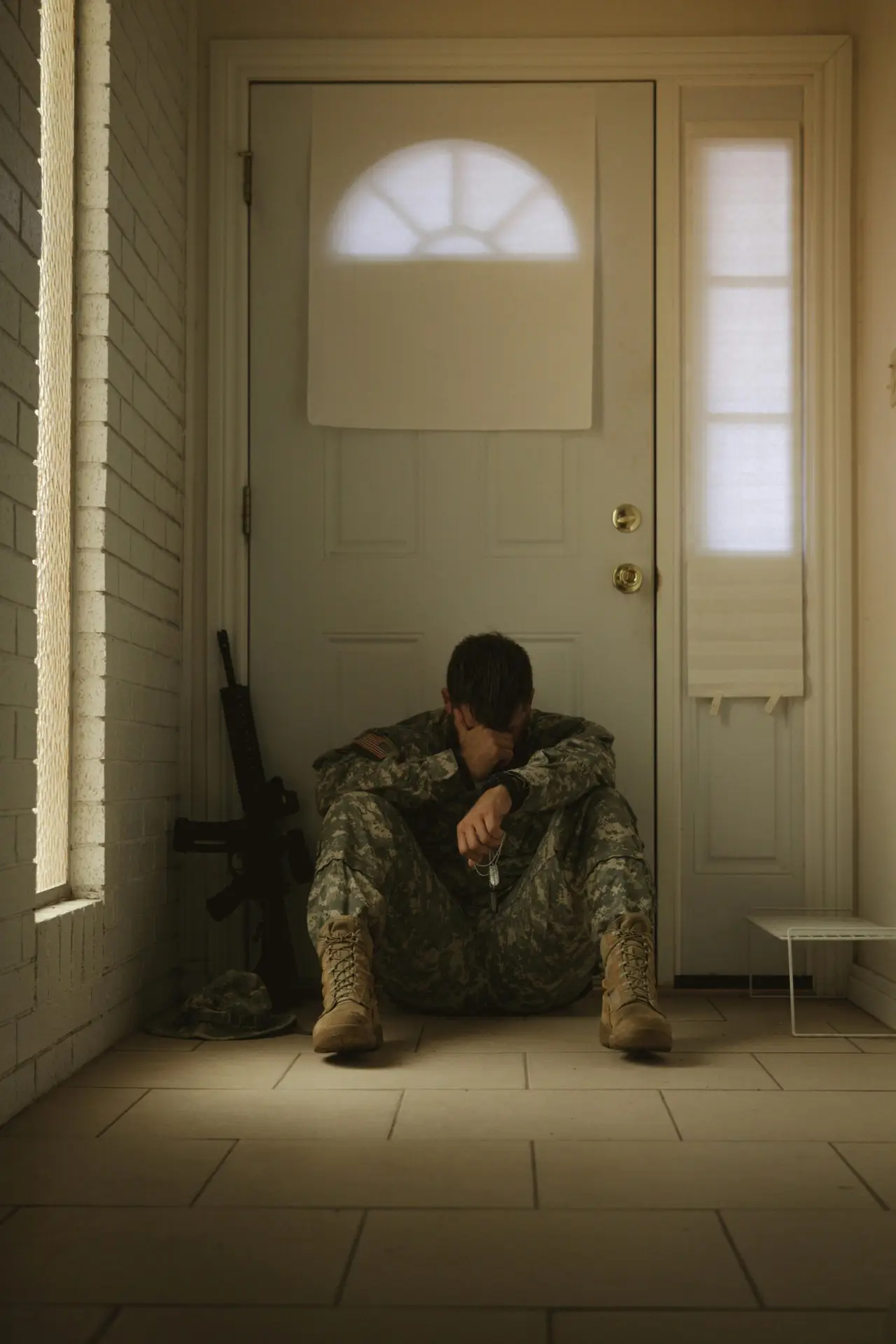
Combat PTSD can leave veterans feeling isolated even in the comfort of their own homes. The shift from the structure of military service to the unpredictability of civilian life can be overwhelming. Many struggle with avoidance, steering clear of anything that reminds them of their trauma and, in doing so, withdrawing further from the people around them.
Feelings of guilt and shame are common too, alongside a belief that they should have been stronger. That self-blame can slide into depression and, frequently, into substance use as a way to numb the pain. This is the point where a coping mechanism quietly becomes an addiction, and where trauma-focused trauma treatment and addiction care need to happen side by side rather than one after the other.
The Impact on Families
As the partner, parent or child of a veteran living with combat PTSD, you are affected too. The emotional distance that accompanies PTSD can leave you feeling helpless, frustrated or resentful. Conversations that once flowed easily become tense, and children in particular may feel frightened by sudden anger or confused by an absence of connection.
When substance use enters the picture, the strain multiplies. The unpredictability of both PTSD symptoms and drinking or drug use makes routines hard to keep and social gatherings a source of stress rather than joy. Families often withdraw, deepening everyone’s isolation. Recognising both conditions is the first step toward genuine stability at home.
Dual Treatment: Healing Trauma and Addiction Together

You do not have to face this alone, and neither combat PTSD nor substance use disorder should be treated in isolation. At Holina Rehab, our Dual Treatment programme is designed for exactly this situation: veterans whose drinking or drug use is rooted in unresolved combat trauma. Rather than stabilising the addiction and leaving the trauma untouched, or vice versa, we address the mind, body and emotions as one connected system.
That means combining evidence-informed trauma work with structured addiction recovery, so the underlying driver and the substance use are treated in the same programme, by the same team. For veterans navigating flashbacks and cravings at the same time, this integrated approach removes the impossible choice of which problem to fix first.
Our care extends to the family, too. Holina Rehab offers family therapy sessions where you can learn how to support your loved one while looking after your own wellbeing, work through conflict, and rebuild trust. For veterans whose symptoms include complex trauma, our PTSD and Complex-PTSD recovery pathway sits within the same integrated framework.
“With combat veterans, the drinking or the drug use is almost never the whole story. It is usually the thing that has been holding the trauma at bay. When we treat the PTSD and the substance use in the same room, at the same time, recovery finally has somewhere solid to stand.” — Marc Rower, Lead Trauma Therapist, Holina Rehab (draft quote, pending sign-off)
Rebuilding Family Bonds
Rebuilding a family after combat PTSD and addiction takes patience, understanding and a willingness to heal together. Communicate openly and without judgment, and remember that PTSD affects the brain: reactions that seem irrational are often survival mechanisms ingrained by trauma. Learning about both PTSD and substance use helps you understand what your loved one is facing and how the two feed one another.
Self-care matters just as much. It is easy to become so focused on your loved one that you neglect your own needs, but therapy, support groups and time for the things you enjoy give you the resilience to keep showing up. Holina Rehab provides educational resources and workshops to help families build these strategies.
A Path Toward Healing
Recovery from combat PTSD and substance use is not a straight line, and setbacks are a natural part of the process. But with the right support, treating both conditions together rather than apart, veterans and their families can find a way forward.
“Holina Rehab was truly a life-changing experience for me. From the moment I arrived, I felt welcomed and safe, surrounded by such a peaceful and beautiful environment. The staff didn’t just do their jobs – they really cared, listened, and supported me through every step. What I loved most was the sense of family and community; I never felt alone in my journey. The therapies and group sessions gave me tools I’ll carry for the rest of my life. If there’s one thing I found challenging, it was that facing myself and my emotions wasn’t always easy – but the team made sure I was never without support. I left feeling stronger, hopeful, and deeply grateful for the experience.”
— Af. Sa., Google review, 4 September 2025
If you or a veteran you love is struggling with combat PTSD and substance use, speak to our team about the Dual Treatment programme. Contact Holina Rehab on +66 82 113 0657 (English) or +66 61 936 8047 (Thai).
Medically and clinically reviewed by Marc Rower, Lead Trauma Therapist at Holina Rehab.
Ready to Start Your Recovery Journey?
Our clinical team is available to answer your questions and help you find the right programme for your needs.
Speak with Our Team →