
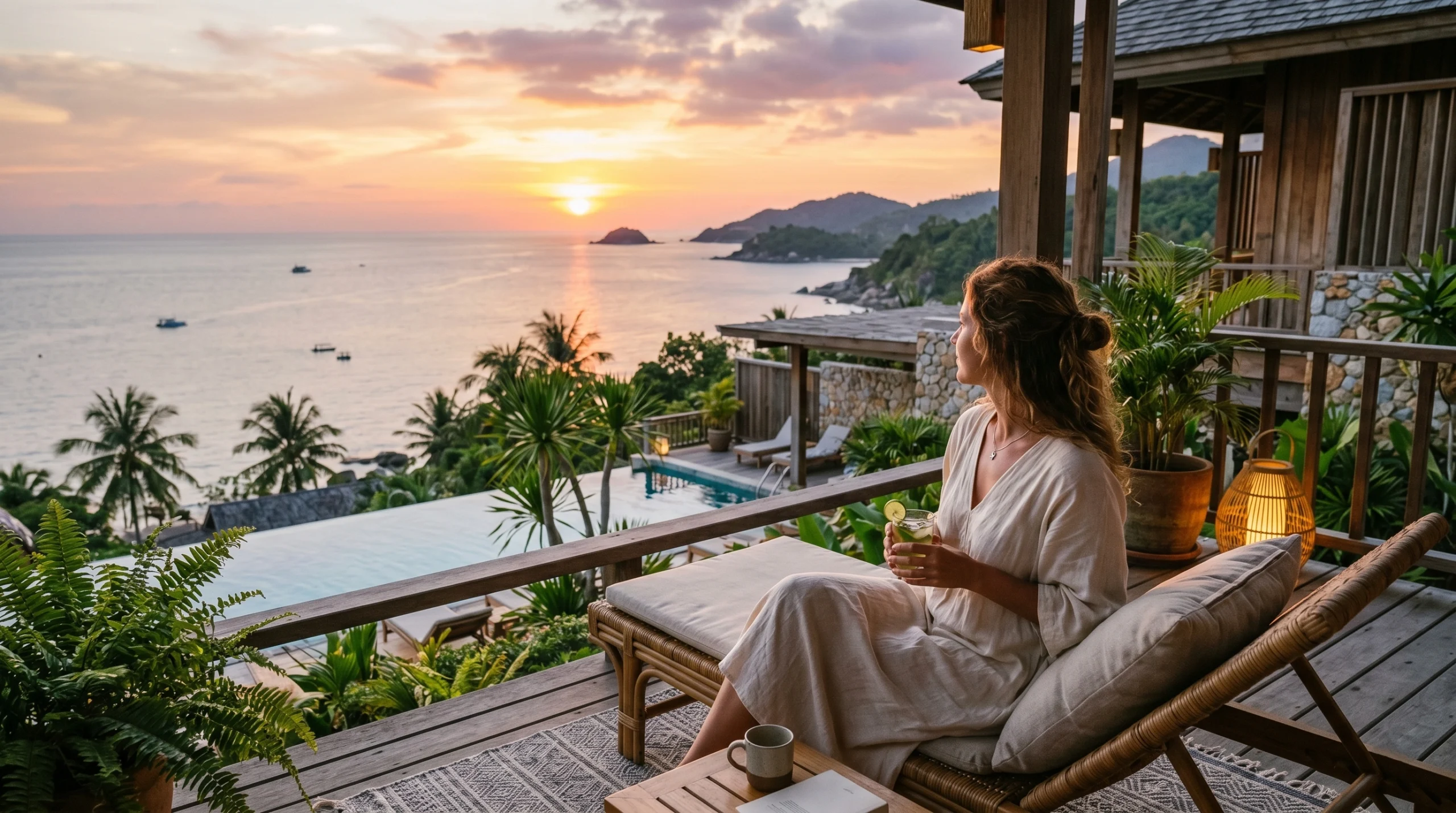
Many people searching for a wellness or treatment setting with sea and sunset views are really looking for something quite specific: distance from the environment where their addiction or distress took hold, and a calmer place in which to do difficult clinical work. This guide looks honestly at what a natural, coastal setting — including the simple daily rhythm of daylight and dusk — can and cannot do for recovery, and how to think about choosing residential treatment in Koh Phangan.
Holina Rehab sits on the quiet side of Koh Phangan and is a licensed residential rehab and detox clinic (#84-03-00294), licensed by the Thai Ministry of Public Health. We are candid throughout: the sea, the light and the surroundings are a supportive backdrop, not the treatment itself. The treatment is the clinical programme — medical care, therapy and structure — not the view.
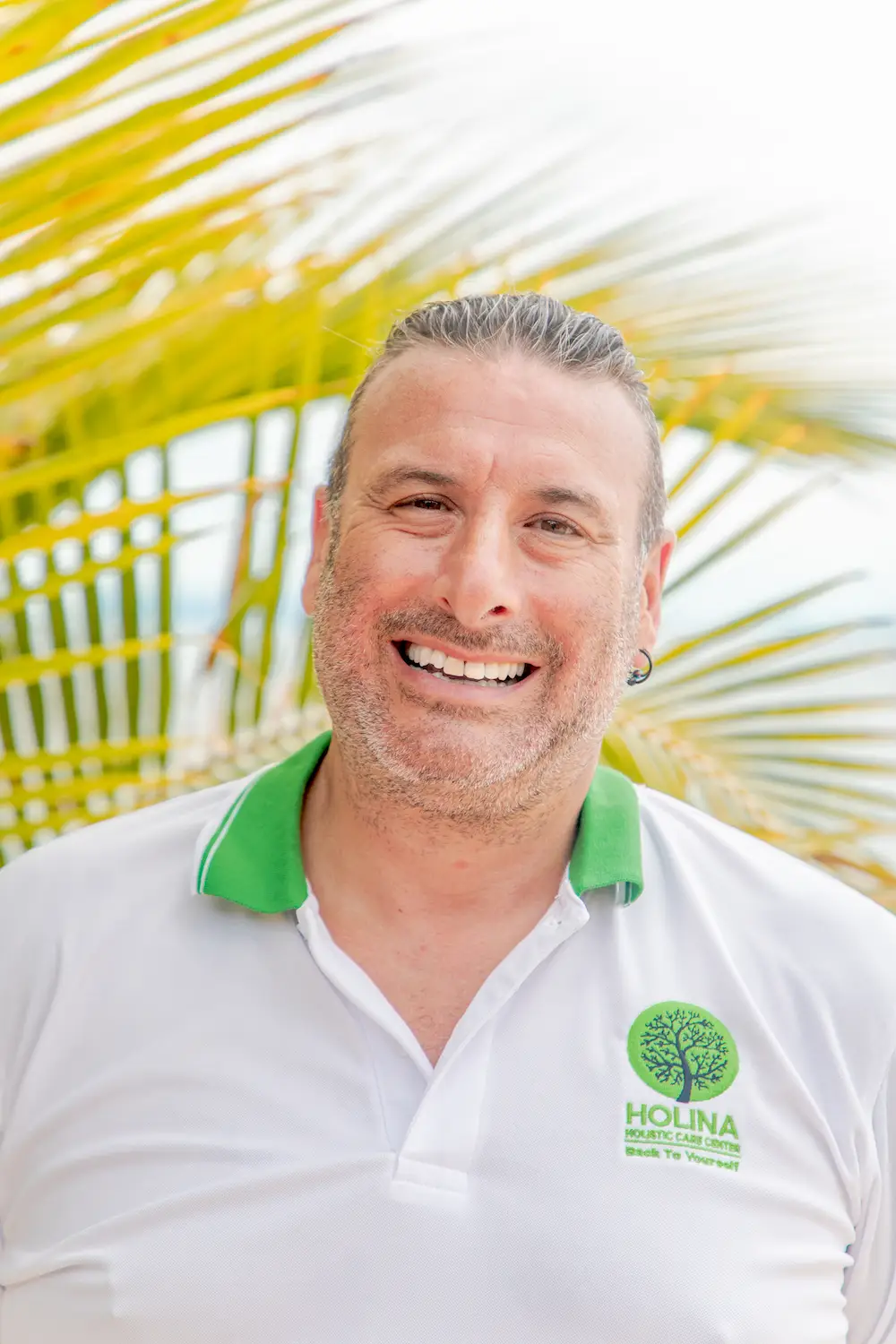
“A good setting helps people settle enough to do the real work — but no view treats addiction. What changes lives here is the clinical programme, and we are careful never to promise otherwise.” — Ian Young
Does the Setting Actually Matter?
To a degree, yes. Research on “blue space” (time spent near water) and “green space” links natural environments with measurable improvements in mood, stress and general wellbeing.[1][2] A calm coastal environment lowers everyday stimulation and can make it easier to rest, sleep and engage in therapy. That is genuinely useful — but it is a supportive condition for clinical work, not a replacement for it. A beautiful location will not, on its own, resolve addiction or trauma.
Daylight, Sleep and the Value of Routine
Substance use and chronic stress commonly disrupt sleep and the body’s circadian rhythm. Regular exposure to natural daylight, consistent sleep and wake times, and less screen light in the evening are among the practical factors associated with better sleep and circadian regulation.[3] A residential setting with a predictable daily rhythm — mornings outdoors, unhurried evenings, and screens set aside — supports this far more reliably than a short holiday can. Watching the sun set over the Gulf of Thailand is not a treatment in itself, but a settled evening routine in a quiet place genuinely helps a dysregulated nervous system begin to rest.
A Short Retreat Versus Residential Treatment
Short wellness breaks can offer a welcome pause, but a weekend rarely addresses the roots of addiction or burnout. Residential treatment differs in depth and duration: medical detox where it is needed, daily therapy, and enough time for change to consolidate. If you are comparing a spa break in Europe with residential treatment in Southeast Asia, the question that matters is not the quality of the view but the depth of the clinical programme behind it.
What a Residential Stay at Holina Includes
- Medically supervised detox with 24/7 nursing and clinical care where clinically appropriate.
- Individual and group psychotherapy, including work with co-occurring behavioural health conditions and underlying trauma through our Dual Treatment programme.
- Somatic and body-based therapies — see our somatic therapies — including breathwork, movement, yoga and water-based work.
- Adjunctive wellness therapies offered on site, such as Hyperbaric Oxygen Therapy (HBOT) and NAD+ IV support, alongside the core clinical programme.
- Comfortable accommodation, chef-prepared meals and a quiet beachfront environment. See our rehab facilities for details.
Cost and Practicalities
Residential treatment is a significant commitment. Our all-inclusive monthly rates currently range from $9,700 for a shared seaview room up to $18,700 for a poolside junior suite, with longer stays — for example a three-month programme — offered at a lower effective monthly rate. For the current, full room-by-room list, please see our rehab prices page. Rates include clinical programming at every level, and there are no hidden fees.
Getting here: most international guests fly into Koh Samui Airport (USM), usually connecting through Bangkok, as there are no direct long-haul flights to Samui. Our team meets you on arrival and arranges the short private transfer, including a boat crossing, to Koh Phangan.
Choosing Well
Look past the photographs. The things that matter most are clinical licensing, the qualifications and experience of the clinical team, the therapies actually offered, and the honesty of what a programme promises. A calm setting and a beautiful sunset are a real comfort during a hard time — but the work of recovery is done in the therapy room, not on the beach.
“the facilities are amazing and the destination of the facility is beautiful, the staff really do make the place so good”
— Matthew Hill, Google Review, 1 Apr 2026 · ★★★★★
If you would like to talk with our team about residential treatment at Holina, we welcome your enquiry.
Sources:
1. Georgiou, M. et al., “Mechanisms of Impact of Blue Spaces on Human Health: A Systematic Literature Review and Meta-Analysis,” PMC, 2021.
2. “Relationship between Green and Blue Spaces with Mental and Physical Health: A Systematic Review of Longitudinal Observational Studies,” PMC, 2021.
3. “A Systematic Review and Network Meta-Analysis… Evaluating Melatonin, Light Exposure, Exercise, and Complementary and Alternative Medicine for Patients with Insomnia Disorder,” PMC, 2020.
Related Reading
Ready to Start Your Recovery Journey?
Our clinical team is available to answer your questions and help you find the right programme for your needs.
Speak with Our Team →