

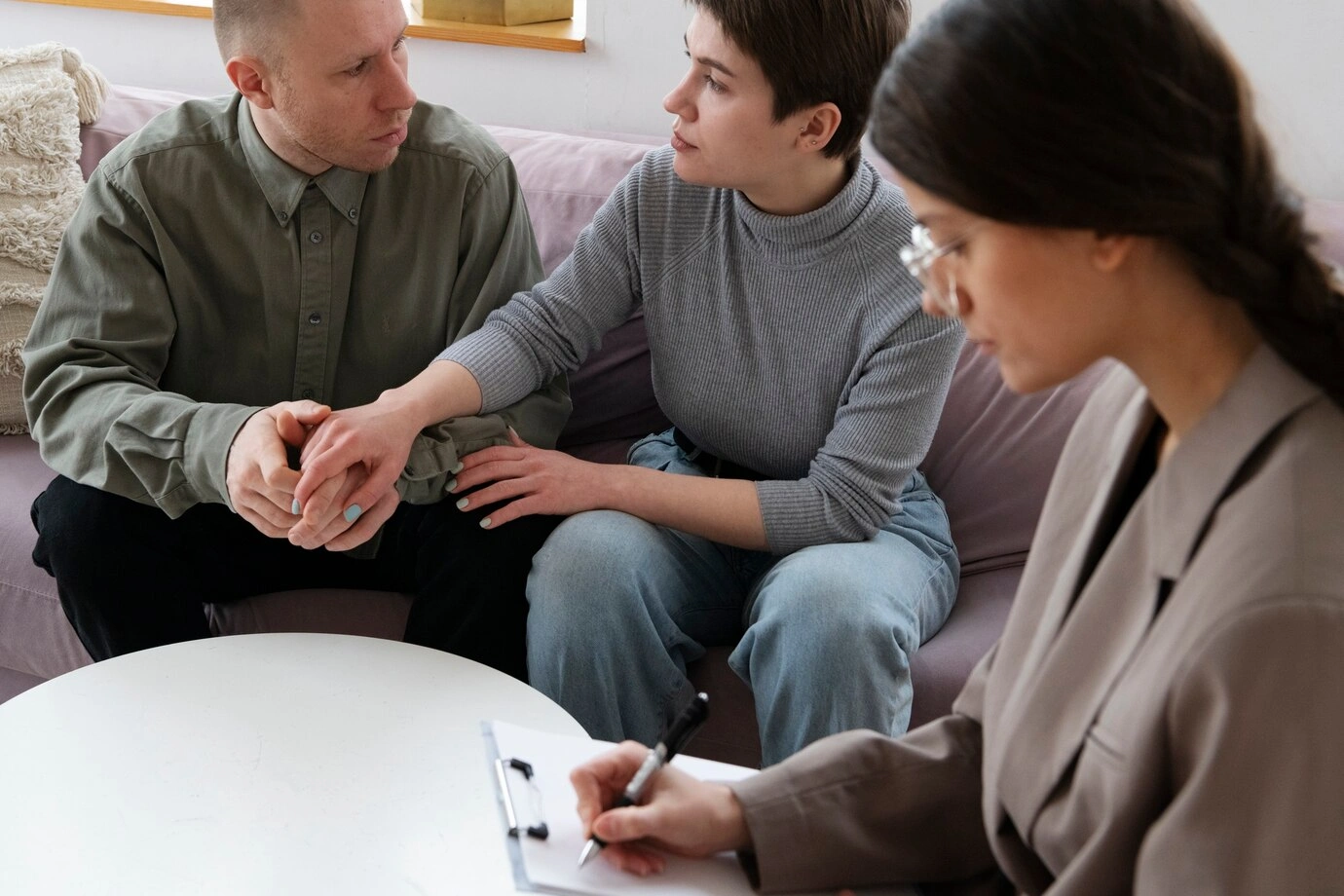
Yes, couples can go to rehab together, and that includes same-sex couples and unmarried long-term partners, not only married ones. At Holina, both partners are admitted to the same beachfront campus, each keeps a separate individual treatment plan, and structured joint sessions are added around that core work. It suits some couples and not others.
By the time you are reading a page like this, you have usually stopped asking whether there is a problem. You know there is. What you are actually trying to work out is the logistics of two people leaving the same life at the same time. Who sleeps where. Whether you will be in the same sessions. What happens to the relationship if one of you does the work and the other stumbles. These are not small worries, and pretending they are does no one any good.
We hear the same handful of questions from almost every couple who enquires, and they are rarely the questions a brochure answers. They are practical, sometimes anxious, occasionally the kind of thing people feel embarrassed to ask out loud. So this piece is built around them directly. If you want the broader case first, our companion piece on why couples rehab works covers the overview; what follows here is the plain answers to what couples actually ask before they decide.
One thing to settle at the outset: when we say “couples,” we mean it in the ordinary, full sense. Same-sex partners, long-term unmarried partners, and married couples are all treated the same way here. The clinical questions are identical regardless of the shape of your relationship, and so are the answers below.
Do we room together, or are we separated?
In most cases partners room separately in the early stages. Shared accommodation can be arranged later where the treatment team judges it clinically appropriate, but it is a decision made with clinicians, not a default you tick on a form.
There is a reason we start apart. Early treatment, and detox in particular, is destabilising, and a partner who is also in acute distress cannot be a steady presence for you, nor you for them. Separate rooms give each person room to sleep, think and do the internal work without managing the other’s state hour by hour. For many couples this is the first stretch in years they have spent apart from both the substance and each other. As stability returns, shared arrangements can be revisited. Accommodation follows the clinical picture, not the reverse.
Can we request separate therapists?
You do not need to request it, because it is already how the programme is built. Each partner has their own individual therapist for their core treatment, and a separate team member facilitates the joint sessions.
This matters more than it first appears. Addiction is treated in the person, not in the couple, and one shared therapist would inevitably start to referee the relationship rather than treat two individuals. Keeping the individual work separate protects your confidentiality and gives each of you a clinician who is unambiguously in your corner. The joint sessions are then a distinct, facilitated space with its own purpose, rather than a blurring of everyone’s roles.
What if only one of us is ready to go?
Then going alone is usually the stronger move, not a lesser one. One partner completing treatment is a better outcome than delaying until both feel ready, and readiness is not something you can borrow from each other.
It is tempting to wait so you can arrive together, but a partner still in active use, or one who is not genuinely committed, tends to slow the work rather than share it. If you are the ready one, the most useful thing you can do is start. A recovered partner becomes a real anchor for the other later, and often the clearest argument the other person ever sees for coming in themselves. If you are weighing this on behalf of a loved one and their partner, the same logic holds; you can start the intake conversation to talk it through.
Does one partner’s relapse affect the other’s treatment?
Each person’s treatment plan stands on its own, so one partner’s relapse does not derail the other’s care. It does, however, become useful clinical information that both the individual and the joint work will draw on.
Relapse is treated as data, not as failure or as a verdict on the relationship. When it happens during treatment, the individual plan is adjusted for the person it affects, and part of the joint work is precisely this: learning to recognise each other’s early warning signs and to respond without either rescuing or blaming. The point of doing some of this together is that the person you live with is often the first to see a relapse coming. Building that early-warning capacity is one of the more durable things couples take home.
What happens if we break up during treatment?
If a relationship ends during treatment, each partner’s individual programme continues uninterrupted. The joint sessions stop; the core treatment does not.
This is one of the clearest advantages of how couples work is structured here. Because your recovery was never contingent on the relationship surviving, the end of the relationship does not end your treatment. We handle the practicalities, including accommodation and scheduling, so that neither person is left exposed, and each continues with their own therapist toward their own recovery. It is not the outcome anyone hopes for, but the model is built so that it is survivable.
Does the research support treating couples together?
Yes, provided the couples work is structured and clinically led. The evidence for adding formal couples therapy to individual treatment is among the stronger findings in addiction care.
A meta-analysis of twelve randomised trials found a clear overall advantage for behavioural couples therapy over individual-based treatment (Cohen’s d=0.54), with the largest single effect in relationship satisfaction (d=0.57). Earlier controlled work reported that around half of men receiving behavioural couples therapy stayed abstinent versus about a third in individual treatment, alongside more abstinent days and a marked fall in partner violence in the year after treatment. National guidance points the same way: the National Institute on Drug Abuse notes that family therapy helps people and their families address influences on drug use and improve overall family functioning. The benefit comes from clinically-led joint work, not from two people simply sharing an address.
“Couples always want the logistics answered first, and they should. But behind every one of those questions is the same worry: will my recovery depend on my partner’s. Our whole model is built so the answer is no. Each person’s treatment stands on its own, and the joint work is added on top of something that would hold up even if the relationship did not.” — Dr. Natalie Lindemann, Clinical Director (Global), Holina Global
What Makes This Work at Holina
Holina Rehab is a residential, medically supervised centre on a beachfront campus in Koh Phangan, Thailand, and couples treatment happens inside that setting rather than as a separate track bolted on beside it. Both partners live on the same campus, but the day is organised around each person’s own clinical programme first, with joint sessions scheduled around it.
The structure that makes the answers above possible is the same one every resident moves through. Most people arriving with a substance use problem also carry an underlying behavioural health condition, and both are treated together through our Dual Treatment programme, offered in 30, 60 and 90-day tiers matched to the clinical picture rather than to convenience. For couples, that assessment runs independently for each partner, which is exactly why one person’s relapse or a break-up need not disturb the other’s care.
The team is real and named. Dr. Natalie Lindemann, our Clinical Director, holds the framework and the line on when joint work is appropriate. Hamutal Cohen, our Psychotherapy Team Manager, leads the therapeutic side so that individual therapy and facilitated joint sessions stay coordinated rather than pulling apart. We also extend the work outward through family and partner support, and you can meet the clinical team before you decide.
Frequently asked questions
Can same-sex and unmarried couples go to rehab together?
Yes. Same-sex couples and long-term unmarried partners are treated exactly the same way as married couples, on the same clinical basis.
Can we be admitted at the same time?
Often, yes, subject to individual assessment and availability. Each partner is assessed separately first, and admission timing is confirmed by the clinical team.
Will we share a room?
Usually not in the early stages. Separate accommodation is the common starting point, and shared arrangements are considered later where clinically appropriate.
Do we get separate therapists?
Yes. Each partner has their own individual therapist for their core treatment, and a separate team member facilitates the joint sessions.
What if only one of us is ready?
Going alone is usually the stronger choice. One partner completing treatment is a better outcome than waiting, and a recovered partner can support the other later.
What happens if one of us relapses during treatment?
Relapse is treated as clinical information, not failure. The affected partner’s plan is adjusted, and recognising each other’s warning signs is part of the joint work.
What if we break up during treatment?
Each partner’s individual programme continues uninterrupted. The joint sessions stop, but the core treatment and accommodation are managed so neither person is left exposed.
Is couples rehab the same as couples counselling?
No. Couples rehab is substance use treatment for two people with joint work added. Couples counselling addresses the relationship and does not provide addiction treatment.
Can we still be treated if there has been violence in the relationship?
Both individuals can still be treated, but not jointly. Where there is violence, coercion or fear, each partner is treated separately and any relationship work waits until it is safe.
How much time is joint versus individual?
Individual treatment is primary and takes the larger share of time. Joint sessions are scheduled around it on a cadence set by the team.
How do we decide between going together and going alone?
The team helps you decide during assessment, based on how entangled the use is and how safe and honest the relationship allows both of you to be. You can contact our admissions team to begin.
What about our children while we are both in treatment?
Care arrangements at home are discussed before admission, so both partners can commit to treatment without a crisis waiting behind them. You can contact our admissions team to talk this through.
Clinically reviewed by Dr. Natalie Lindemann — Clinical Director, Holina Global · Last reviewed 20 July 2026.
Ready to Start Your Recovery Journey?
Our clinical team is available to answer your questions and help you find the right programme for your needs.
Speak with Our Team →