

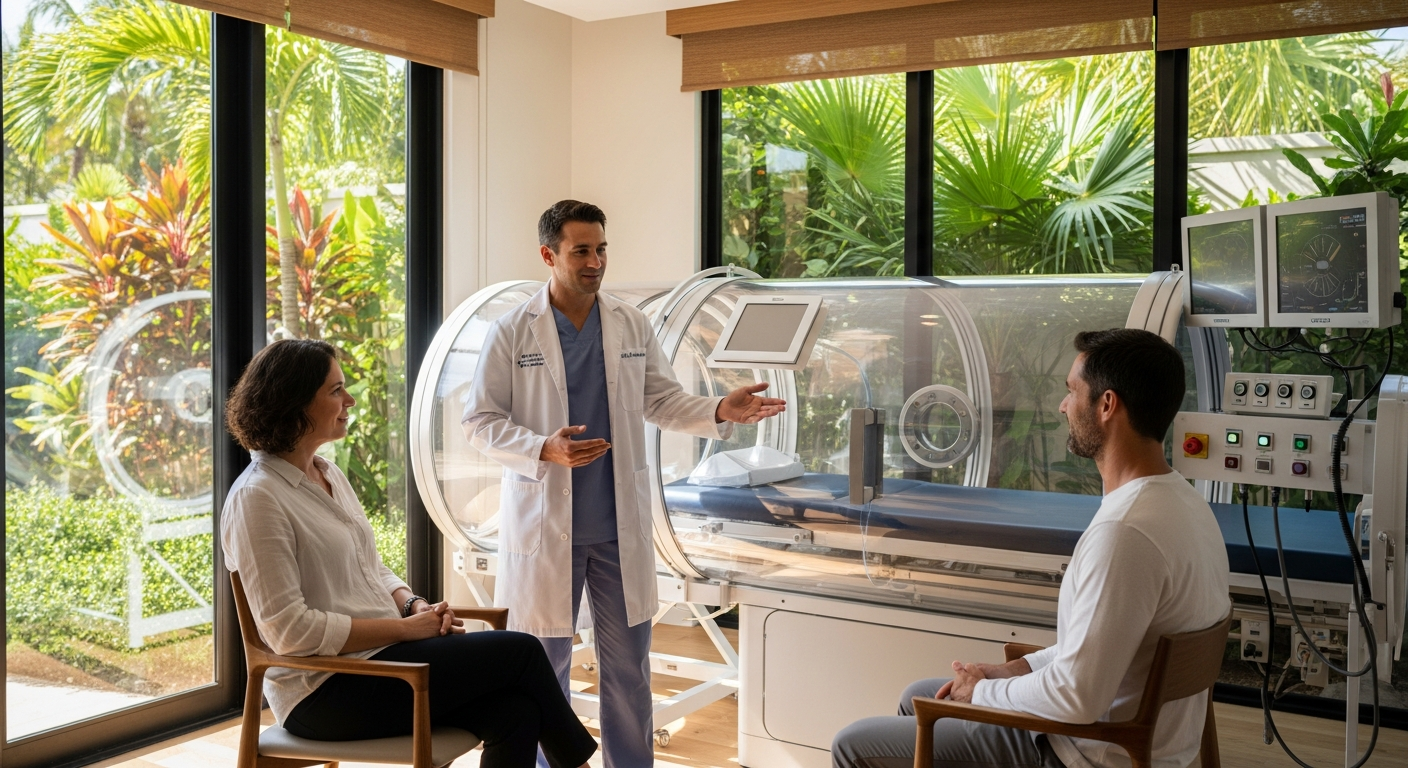
Hyperbaric oxygen therapy has earned a well-established place in integrative and rehabilitation medicine, and its growing role in addiction recovery and trauma healing is drawing serious clinical interest. But if you’re considering HBOT as part of your treatment programme — whether at home or here in Thailand — it’s completely natural to have questions. What actually happens inside a hyperbaric chamber? Are there real risks involved? And how do you prepare for a session that delivers the greatest possible benefit?
The honest answer is that HBOT is widely regarded as a comparatively low-risk therapeutic intervention when delivered under proper physician supervision, with a well-documented safety and complication profile built up over decades of clinical use.1,2 Like any medical treatment, however, it comes with important considerations that deserve a clear, grounded explanation — not the kind of breathless enthusiasm that glosses over the details, and not the kind of clinical language that leaves you more confused than reassured.
At Holina Rehab on Koh Phangan, Thailand, every hyperbaric oxygen therapy session is delivered within a personalised, medically supervised treatment framework. Our approach is rooted in evidence-based practice, which means we believe you deserve accurate, transparent information before you step inside a chamber for the first time. Understanding HBOT safety and side effects, knowing the real hyperbaric oxygen therapy risks and how they are minimised, and having a reliable HBOT preparation guide are all part of what makes the experience both safe and deeply therapeutic.
This post walks you through everything you need to know — thoughtfully, honestly, and with the care you’d expect from a team that genuinely has your wellbeing at the centre of everything we do.
HBOT Safety: What the Evidence Actually Tells Us
Hyperbaric oxygen therapy (HBOT) has been used in clinical medicine for decades, originally developed to treat decompression sickness in divers before researchers began uncovering its broader therapeutic potential. Today, it is recognised as a well-studied adjunctive treatment with a documented safety and complication profile — provided it is administered correctly, in an appropriate clinical environment, and under the supervision of a qualified physician. Understanding what makes HBOT comparatively safe, and where the genuine risks lie, allows you to approach your sessions with informed confidence rather than unnecessary anxiety.
At its core, HBOT works by having you breathe high concentrations of oxygen inside a pressurised chamber, typically at 1.5 to 3 times normal atmospheric pressure. This significantly increases the amount of oxygen dissolved directly into your blood plasma, reaching tissues that compromised circulation might otherwise leave under-oxygenated. The mechanism is straightforward physiology — and it is precisely because the process involves elevated pressure and concentrated oxygen that proper protocols matter.
The most important safety consideration is that HBOT should always be physician-supervised. Before your first session, a thorough medical assessment is essential. Certain conditions require careful evaluation before proceeding. According to clinical guidance on HBOT contraindications, these include:1
- Untreated pneumothorax (collapsed lung) — this is the one absolute contraindication to HBOT, as pressure changes during a session can precipitate a life-threatening tension pneumothorax
- Uncontrolled high fever (above roughly 39°C) — fever lowers the seizure threshold, which matters in a high-oxygen environment
- Certain medications — drugs such as doxorubicin, cisplatin, and disulfiram require individual clinical review, as they can interact with hyperbaric oxygen and must be disclosed during your pre-treatment assessment
- Chronic obstructive pulmonary disease (COPD) with carbon dioxide retention — a relative contraindication requiring individual clinical review before proceeding, due to the risk of hypercarbia
- Severe claustrophobia — worth discussing openly with your care team, as modern chambers and supportive preparation can make sessions far more comfortable than many people anticipate; in rare severe cases it may be treated as a contraindication if it poses a safety risk during the session
For the vast majority of people entering a residential wellness or rehabilitation programme, none of these contraindications apply — but the screening process exists precisely to confirm this individually, not as a formality. A personalised treatment approach means your physician reviews your complete health history, current medications, and any recent imaging or bloodwork before your first session is scheduled.
It is also worth understanding what the research actually shows about frequency of complications. A 2023 systematic review and meta-analysis of HBOT adverse effects found that patients receiving HBOT reported adverse effects more often than control groups (roughly 30% versus 10% across the pooled studies), with mild ear discomfort the most frequently reported issue and minor, reversible eye changes the next most common.2 The same review found that risk rose somewhat with longer courses (more than 10 sessions) and higher chamber pressures (2.0 ATA or above) — one of the reasons your treatment protocol at Holina is individually calibrated rather than one-size-fits-all. Serious complications, such as pulmonary barotrauma or oxygen-related seizures, are rare: one clinical reference source estimates generalised seizures occurring in roughly 1 in every 5,000 to 10,000 treatment sessions, and notes that these resolve once normal air breathing resumes.3 The therapy is not experimental in the way that some wellness treatments are — its physiological mechanisms are well-documented, its risks are known and actively managed, and its delivery can be carefully calibrated to your individual tolerance and therapeutic goals.
“The single most reassuring thing I can tell a new resident before their first HBOT session is that we screen thoroughly before anyone enters the chamber, and the side effects we do see are almost always mild, temporary, and expected. Informed patients are calmer patients.”
What to Expect During Your HBOT Sessions: A Walk-Through of the Experience
For many people, the idea of climbing into a hyperbaric chamber feels unfamiliar — even a little daunting. Understanding exactly what happens before, during, and after each session can help dissolve that uncertainty and allow you to arrive feeling prepared and at ease. At Holina Rehab, your first HBOT session is always preceded by a thorough assessment with our supervising physician, who reviews your medical history, current medications, and treatment goals before a single session begins.
On the day of your session, you will be asked to change into 100% cotton clothing. This is a standard safety measure, as synthetic fabrics can generate static electricity in oxygen-rich environments. You will also be advised to avoid alcohol-based products, perfumes, and aerosol sprays beforehand. These precautions are straightforward and your care team will walk you through each one clearly.
Once you enter the chamber and it begins to pressurise — typically to between 1.5 and 3 atmospheres absolute, depending on your personalised treatment protocol — you may notice a sensation of fullness in your ears, similar to descending in an aeroplane or diving underwater. This is completely normal, and it is also the single most commonly reported sensation associated with HBOT.2 The most effective way to manage it is through swallowing, yawning, or gently pinching your nose and blowing softly — a technique known as the Valsalva manoeuvre. Your care team will demonstrate this before your session begins.
Sessions typically last between 60 and 90 minutes. During this time, most people find they can relax comfortably. Many clients at Holina listen to music, watch a film, or simply rest quietly. The environment inside a modern monoplace or multiplace chamber is calm and controlled, and our team remains in full communication with you throughout.
After the session concludes, the chamber depressurises gradually — a process that takes around 10 to 15 minutes. You may feel a pleasant sense of calm, mild fatigue, or, for some people, a gentle lightness or clarity of mind. These are common responses and generally settle within an hour or two.
“Luxurious surroundings, the very best A+ care, and a varied and interesting programme.”
— Nish, Recovery.com Review, 17 Apr 2025 · ★★★★★
A standard course of HBOT at Holina typically involves multiple sessions scheduled across your residential stay, allowing the cumulative physiological benefits to build progressively. Key practical points to remember include:
- Arrive well-hydrated — adequate fluid intake supports healthy circulation and helps your body respond more effectively to increased oxygen delivery
- Avoid heavy meals immediately before your session, as a full stomach can increase discomfort during pressurisation
- Inform your physician of any recent chest infections, sinus congestion, or ear discomfort, as these can temporarily affect your suitability for that day’s session
- Avoid smoking before sessions — nicotine constricts blood vessels and can reduce the therapeutic benefit of elevated oxygen levels
- Your session frequency and pressure level will be reviewed and adjusted throughout your stay based on your individual response and clinical progress
The experience is considerably more comfortable than many people anticipate, and the structured, physician-supervised approach at Holina ensures that each session is purposeful, carefully monitored, and integrated meaningfully into your broader recovery programme.
What to Expect Before, During, and After Your HBOT Sessions
Knowing what lies ahead can make all the difference when you are preparing to begin a new treatment. Hyperbaric oxygen therapy is non-invasive and well-tolerated by most people, but walking into your first session with a clear picture of the process helps you feel grounded, informed, and in control of your own care.
Before your sessions begin, your physician will conduct a thorough medical evaluation. This includes reviewing your current medications, medical history, and any respiratory or cardiovascular conditions that may require additional monitoring. Certain medications — including some chemotherapy agents and lung-sensitising drugs — require careful assessment prior to HBOT, which is why physician supervision at every stage is not optional; it is essential. You will also be advised to avoid alcohol and tobacco for several hours before each session, as both can impair your body’s oxygen-carrying capacity and may reduce the therapeutic benefit.
On the day of your session, you will be asked to change into 100% cotton clothing, as synthetic fabrics carry a small static electricity risk inside a pressurised oxygen environment. No lighters, petroleum-based skin products, or electronic devices are permitted inside the chamber. These precautions are standard across accredited hyperbaric facilities and are simply part of the safety protocol.
Once inside the chamber, you will notice a gradual increase in pressure — similar to the sensation of descending in an aircraft or diving below the surface of water. Most people find this entirely manageable. You may feel a mild fullness in your ears, which is relieved by swallowing, yawning, or gently equalising pressure as you would on a flight. Sessions typically last between 60 and 90 minutes, during which you can rest, listen to music, or simply breathe slowly and comfortably.
After your session, you may feel pleasantly relaxed, mildly fatigued, or occasionally lightheaded — all of which resolve quickly. Some individuals report improved sleep quality and mental clarity within the first few sessions. A small number of people experience temporary short-sightedness (myopia) across a longer course of treatment — a well-documented and, according to clinical sources, fully reversible effect that typically improves within weeks of finishing treatment — or minor ear discomfort; both are monitored closely by your clinical team.3
At Holina Rehab, HBOT is never offered as a standalone intervention. It forms one carefully considered layer within a personalised, evidence-based programme that addresses the neurological, emotional, and physical dimensions of addiction and trauma recovery. Every session is overseen by experienced medical professionals and integrated with therapies including individual counselling, trauma-informed care, and holistic wellness practices — ensuring that the oxygen your brain receives is matched by the depth of support surrounding your entire healing journey.
- Arrive well-hydrated — adequate hydration supports healthy circulation and helps your body make full use of elevated oxygen levels during each session.
- Avoid alcohol and tobacco for at least four hours before treatment to help preserve the integrity of the therapeutic response.
- Wear comfortable, natural-fibre clothing — your care team will guide you on exactly what to bring and what to leave outside the chamber.
- Communicate openly with your physician — any changes in how you feel between sessions, including new headaches, visual changes, or ear pain, should be discussed promptly.
- Approach each session with patience — neurological and physiological benefits, where present, tend to accumulate gradually across a full course of treatment rather than appearing after a single session.
Healing is rarely linear, and the most thoughtful recovery programmes are those designed with both scientific rigour and genuine human understanding. HBOT at Holina Rehab is offered in exactly that spirit — as a carefully considered, medically grounded tool within a luxury residential environment where every element of your care is thoughtfully aligned with your long-term wellbeing.
Hyperbaric oxygen therapy is a well-researched, physician-supervised treatment with a documented safety profile when delivered within a professional clinical setting. Like any therapeutic intervention, it comes with a number of potential side effects — most of which are mild, temporary, and easily managed by an experienced medical team. Understanding what to expect before, during, and after each session allows you to approach HBOT with confidence and engage fully in the healing process.
If you or someone you love is exploring evidence-based therapies to support addiction recovery, trauma healing, or overall wellbeing, we warmly invite you to reach out. The team at Holina Rehab is here to answer your questions honestly, without pressure, and help you understand whether HBOT could be a meaningful part of your journey. Contact us today to begin the conversation, or visit our intake page to learn how admissions work.
Sources:
1. “Hyperbaric Oxygen Therapy Contraindications,” StatPearls, NCBI Bookshelf.
2. “Adverse effects of hyperbaric oxygen therapy: a systematic review and meta-analysis,” Frontiers in Medicine / PMC, 2023.
3. “Hyperbaric Complications,” StatPearls, NCBI Bookshelf.
Ready to Start Your Recovery Journey?
Our clinical team is available to answer your questions and help you find the right programme for your needs.
Speak with Our Team →